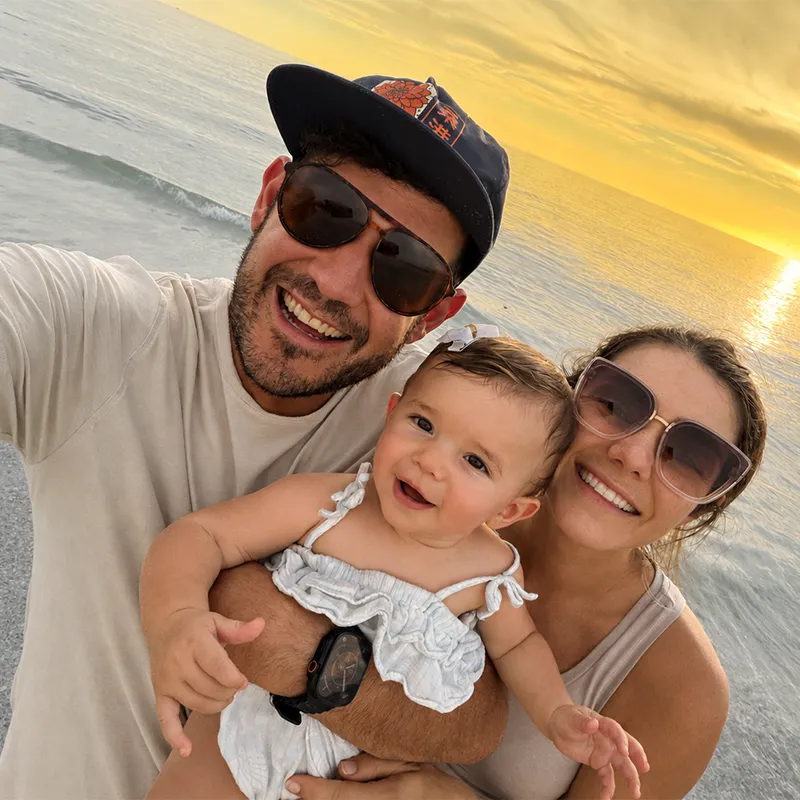
It's difficult to believe how uncertain Michael Sarlo's future used to be when he reflects on his life today - a successful job, a loving wife, a nine-month-old daughter Stella, and almost two decades of cancer survivorship.
In 2009, while Michael was in his early twenties, he was diagnosed with a rare and aggressive form of testicular cancer. His journey was anything but simple. Doctor after doctor had initially ruled out cancer, but as his symptoms worsened, Michael spent over a year looking for answers before he was diagnosed correctly.
“It was a long battle just to get a proper diagnosis,” Michael said. “Nobody expects someone in their twenties to have cancer.”
Michael initially thought his abdominal pain was due to a hernia that resulted from lifting beer kegs while working at a restaurant in Boston. As months went by, he struggled with persistent pain, lost weight, and continued to grow weaker. Professionals assured him that nothing was wrong despite numerous ER visits, imaging tests, and a variety of doctor appointments.
“I knew my body,” he remarked. “But something didn’t feel quite right; I kept going back because I knew something was wrong.”
There was one person who kept Michael from giving up—his restaurant colleague, who himself survived testicular cancer. He constantly urged him to continue seeking answers. In retrospect, Michael feels that it was his colleague’s persistent urging to get a second opinion that made all the difference in his story’s outcome.
After changing medical professionals, Michael eventually got the diagnosis that had eluded him for 8 months: embryonal carcinoma, an aggressive and uncommon type of testicular cancer that had already spread elsewhere.
In the end, one of Michael’s biggest advantages was the fact that he was living in Boston. It allowed him to receive treatment from world-class medical professionals at Dana Farber Cancer Institute and Brigham and Women's Hospital. But the road ahead wasn't easy. Without knowing anyone his age who had experienced cancer, Michael was forced to make life-altering decisions based on drastically different treatment recommendations from multiple doctors.
Surgery, weeks in the hospital, chemotherapy, and months of recovery were all part of Michael's cancer journey. In addition to the physical trauma to his body, he had to deal with the financial strain of supporting himself while unable to work and struggling to pay for his education.
“I was definitely depressed,” Michael said, describing the mental impact that lasted even longer than the physical one. "For years afterward, I carried a lot of anger. When you're diagnosed young, you lose that feeling of being invincible much earlier than most people."
One of Michael's most significant outlets during his treatment was music. He explained that at trying times in his life, he always found comfort in playing the guitar, something he continues to do now while also incorporating other instruments.
Following his recovery, Michael went back to work, completed his studies at UMass Boston, and became one of the founders of HaystackID. The company helps corporations, law firms, and insurance carriers manage complex legal, regulatory, and cybersecurity matters through digital forensics, advisory artificial intelligence, attorney review, and eDiscovery services. The company has grown significantly since its days as a start-up and today it has $250 M+ in revenue. Michael serves as Chief Innovation Officer and President of Global Investigations and Cyber Incident Response. Developing a thriving business served as one of the many reminders that the remainder of his life will not be defined by the disease.
Michael says he avoided discussing his cancer survival in public for a long time.
“There was always this feeling that maybe people shouldn't know,” he remarked. “It wasn't something someone said directly, but it was understood.”
Michael eventually came to the realization that others could benefit from his experience and he could provide them with the same kind of emotional support that he wished he had received during his treatment.
He found Cancer Hope Network because of that insight. By connecting patients and caregivers with trained Peer Mentors who have faced similar experiences, the organization helps ensure that no one has to face cancer alone.
“I didn't have peers to talk to,” he said. “The other patients I encountered during treatment were much older than I was.”
Looking back, Michael's decision to become a Peer Mentor was profoundly influenced by his loneliness. He didn't want any other young adults dealing with cancer to experience the same level of isolation. His organizational commitment goes beyond his role as a mentor and he currently serves on the Young Professionals Advisory Committee of Cancer Hope Network, where he supports fundraising initiatives that broaden the organization's reach, raise awareness, and link younger survivors with resources.
“The reason I was drawn to Cancer Hope Network was that I felt like there was a gap,” he said. “Patients who are informed, empowered, and connected have better outcomes. Speaking to someone who's been there really matters," he adds.
Michael now teaches others that self-advocacy is one of the most crucial things you can do. He hopes that every discussion he has with fellow cancer patients serves as a reminder to others that they are not alone. He learned the value of hope, perseverance, and self-advocacy from his own journey, and now is dedicated to assisting others in learning the same skills during one of the most trying times in their lives.
Having spent more than a year looking for answers, Michael knows how crucial it is to follow your gut and keep asking questions until you receive the treatment you deserve.
“If you think something is wrong with your body, something is usually wrong. You need to advocate for yourself and find people who will advocate with you.”
In addition to his career, Michael is thankful for his life, which cancer almost took away from him. He says that becoming a parent is one of his greatest blessings. He is happily married to Mandi and just welcomed their daughter Stella, something especially meaningful since he once questioned whether chemotherapy would prevent him from having children.
As he watches his daughter Stella grow up, every day is a reminder of how far he has come and a future he wasn't sure he’d have.
His message is clear and effective for those just starting their own cancer journey:
"This too shall pass," Michael said. "You may not be able to see the light at the end of the tunnel right now, but it will come. Hold on to hope, believe you're going to survive this, and know that life can be amazing again."